
|
On April 15, 1660, the Dutch ship De Bonte Koe ('The Spotted Cow") set sail from Amsterdam with soldiers, settlers, and supplies for the Dutch colonies along the Hudson River in North America. Of the eighteen soldiers on board, only Pieter Pieterzen, progenitor of the Ostrander family in America and a cadet in the army of the Dutch republic, was accompanied by his wife, Tryntje, and three children, Pieter, Tryntje and Geestje. Two months later the ship arrived off Nieuw Amsterdam, the Dutch colonial capital at the tip of Manhattan Island. Shortly afterward, the Pieter Pieterzen family was among the seventy or so settlers at the farming community call Esopus, about ninety miles upriver on the Hudson.
In the previous autumn, Indians had attacked and laid siege to Esopus for three weeks. In June of 1663, they attacked again and this time penetrated the stockade. Twelve homes went up in flames, twenty one Dutch settlers were killed and forty five, mostly women and children, were taken captive. Nieuw Dorp, a new settlement three miles to the west, was entirely destroyed.
A secondary source states that 'tradition says the family fell victim to Indians" but documentary evidence is lacking and the "tradition" was not widely handed down within the family. Whatever the case, the three children of Pieter Pieterzen (1) survived and raised large families of their own. Pieter Pieterzen (2), the Dutch army cadet's only son, married a neighbor daughter, Rebecca Traphagen, and to this union thirteen children were born. Eight of these were boys, of whom seven are known to have descendants carrying on the direct family line to this day.
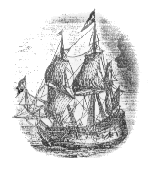 De Bonte Koe means The Spotted Cow. While little is known of de Bonte Koe, it is surmised that the ship was 170 feet long, 49 feet in beam, and about 20 feet in depth, based on similar ships of the period (Historical Handbook, 1935). The above rendition of de Bonte Koe is from the Holland Society and was publshed in the January 1996 edition of the Van Voorhees Niewsbrief.
Generated by GenDesigner 2.0 beta 3.6